FRETS.NET
Nut compensation
This is the last installment of my trilogy containing the "composite saddle bone", the "spruce bridge plate" and now the "nut compensation". These three things works in harmony on my restored old guitars and to my ears gives them a way better sound than expected :-)
Intonation is a field with many theories and opinions. Here I describe a practical way to use the nut and not just the saddle to improve intonation on any fretted instrument. The information found in the site setitupbetter.com is the base for the method.
To use the nut for intonation purposes gives the possibility to have almost "perfect" intonation on two different spots on the fretboard. With standard intonation the intonation will be great at the 12'th fret only. The intonation in the upper fret area of the fretboard are really bad indeed. Incidentally, that's where the majority of all guitar players play their chords ;-)
The main problem is that all fretted notes have a higher pitch than the open strings due to the stretching of the fretted strings. Another major problem is the need to have the nut a bit higher to avoid fret buzz from open strings (they are longer, vibrates more and are often played harder than fretted notes, back buzz behind a capo is another problem). Chords with a blend of fretted notes and open strings will sound out of tune with the standard intonation, especially the chords taken near the nut.
After reading the info on the site mentioned above, I came up with a way to measure the intonation points in the nut and the saddle. Using the measures I then cut the fingerboard shorter (around 1 mm shorter) at the nut and use a dremel and files to shape the nut and saddle so the string leaves the nut/saddle at the measured intonation points.
I use a stroboscope tuner and use it to make sure that the open string, the fretted third and 12'th notes on each string is in tune. I do this by moving the intonation points at the nut and saddle to a forth (retuning after every movement) until the equation is solved and all the three notes on the string is in tune. The positions are measured and written down.
While measuring, the "nut" consists of small bits of tangless frets acting as an adjustable "zero fret" and the "saddle" is the back ends of drills rolling on top of the bridge. A temporary tailpiece is used to fasten the strings. A small piece of spruce is used to make the fretboard a bit longer at the nut to make room for the movable frets, a 0.15 mm feeler gauge gives the "nut" a bit more height to emulate the optimal string height at the 1'th fret. Another piece of spruce is needed to fill out the saddle slot if there is one.
 It's easier on an electric guitar, no need for a tailpiece and drills.
The final intonation points on the electric guitar above. Small compensations on the nut was needed on this one, but I had to extend the width of the nut about 1 mm closer to the 1'th fret.
I measure the distance from the back side of the 1'th fret to the middle of the "zero" fret for each string with a digital caliper and the distance from the same backside of the 1'th fret to the intonations point at the saddle with a ruler. I put the measurements in a table (mm and cm).
It's important to check the string height at the 12'th fret, it shall be the one used when playing. For the electric guitar I use a standard 2,5/1,5 mm between the top of the fret to the underside of the string. Having the stringset that the player likes and will use is another good thing to make the intonation as good as possible. The tuning shall be the one most used when playing. The fretboard should have the right relief too. In a nutshell, all the setups and choices should be done before the measuring for intonation.
By cutting the fretboard shorter at the position for the intonation point closest to the 1'th fret, the nut can be rectangular and all the other intonation points can be reached with a dremel. The nut looked like this when cut. Only with a close inspection of the nut you will notice the jagged cuts.
Not a great example, the G and D came close and I decided to leave both of them uncut when measuring the nut blank on the guitar... I should have cut in 0.16 mm on the G string...
Every guitar have small variations of the intonation points. There is no "one size fits all".
On acoustic guitars I have noticed though that it's the A or b strings that usually comes closest to the 1'th fret. At the saddle the strings G-e is often a straight line and the E-D strings can vary a lot. The electric guitar example above is not typical, the variations at the nut is usually bigger.
I made a special tool to shuffle the fret bits at the nut like this.
 I found a drill bit set with drills in steps of 0.1 mm between 6 mm to 0.1 mm. Very handy to adjust the string height at the 12'th fret with a radiused fretboard. I mark the position of the intonation point on the nut blank with small bits of tape to make it easier to cut in to the right spot.
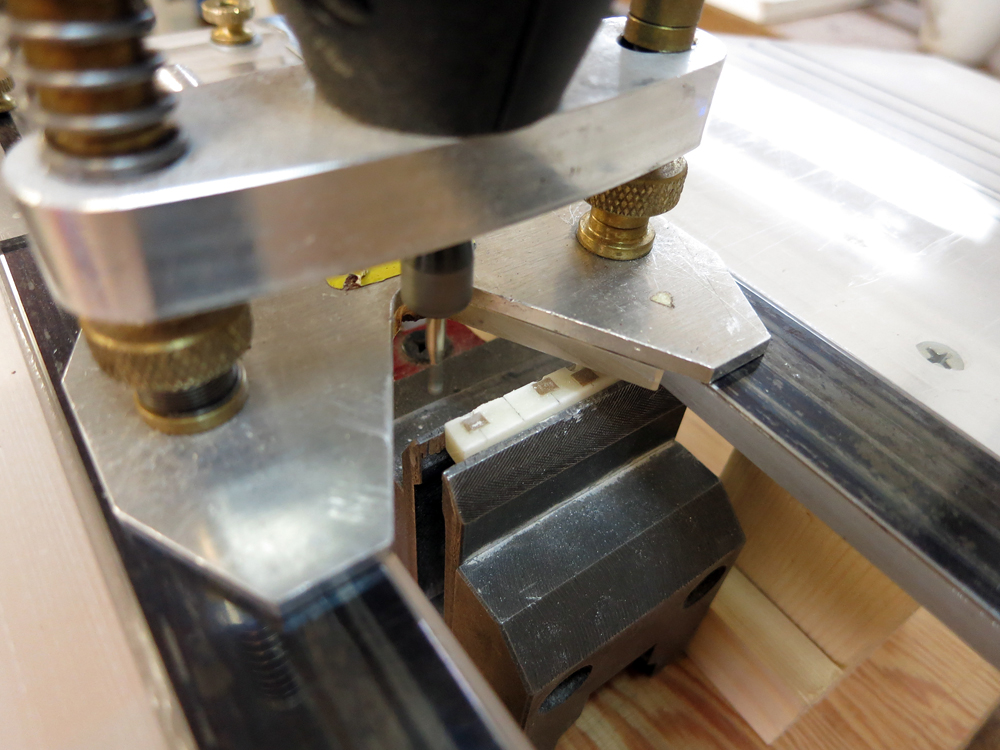
 I made a jig for the Dremel using my modified version of the Stewmac saddle slot jig.

 Here is the finished nut, a rather typical one for an acoustic guitar.
 Doing a nut compensation like this makes the guitar chords near the nut play beautifully in tune. I believe that even a capo will play better since the saddle is only intonated for fretted notes (as the capo is) instead of a blend of fretted notes and the problems at the nut!
Without a nut compensation, every fretted instrument WILL be out of tune when playing chords near the nut. The difference is is a major one.
The nut intonations is quite stable. The intonation is very good even when a different set of string gauges or alternative tunings are used. I for one is not as sensitive to pitch as the stroboscope tuner is! On an electric guitar it's always a good thing to intonate the "good old way" for the new set of strings, that will make the guitar play cleaner in the lower part of the fretboard. There are always variations between different sets of the same string brand, but most of the time the difference is small.
The measuring process usually take me one hour. Making the compensated nut and composite saddle another couple of hours. All in all, it's about a half a days work if nothing goes wrong. The upside is the result obviously, but the measurements also makes it impossible to cut the saddle slot in the wrong position :-)
Ned Knepp
Ok, Primary school kid here, poking his head into the room with the big kids... be kind.
I haven't ever understood the underlying idea behind compensating the nut. I get what it can do for open strings but I don't see how this does anything for a fretted string since the whole point to fretting is to move the stop point of the string (nut, if you will).
From my foggy memory of long ago physic classes, I seem to remember that most vibrating strings actually have several node points where the oscillation is very small while the center between these points will move with a greater "swing". Unless the strings are tuned to a specific frequency/tension, there probably isn't a single "wide swing point on the string. IF I remember this correctly, this explains why we can have our strings so close to the frets despite the various tensions/size of strings we use. It also goes a long way toward explaining why "that fret buzz" isn't always in the middle of the string.
In short, the string has several points of narrower and wider vibration patterns depending upon the length/tension/gauge of the string, the combination of which is what sets the pitch/frequency... no matter where the stop points are located. If you change one parameter, it will effect the position of the nod points. A slight change in thickness may be small in influence while lengthening even a little can have a much greater influence. IF this is so, a change in the string length created by moving the stop point on one end of the string must be compensated for with changes in the other parameters. Either the tension must be increased or the size of the string or even both to return the string to it's required frequency. Unfortunately, every stop point between the terminal ends will also need to be adjusted so that each of them are also suited for the new parameters because changes to the tension, length, size, cause the node points to shift as well.
That is, unless the opposite stop point is also moved, which essentially returns the string to the original specs, albeit, in a new, overall position. IF I'm correct, the node points are important because these are where it's easiest to "stop" the string and select a new frequency (note) stopping the string at the center point between nodes doesn't maintain the scale step needed because it create a string which radically shifted node points meaning that all the "notes" available are not in tune with the new "original" frequency created by the new, open string, stop point.
This is a big part of the problem I have with understanding why nut compensation would do anything for a fretted note. To my thinking. shifting only one end of the string, even a tiny bit changes the "in tune" stop points between the terminal points. This is, of course, exactly what we want when we compensate the bridge string stop points but unlike nut compensation, the bridge compensation applies to every note on that string, not just the open string. The problem I see is that moving both stop points doesn't actually change anything and changing the stop point at the nut forces every fretted note to be out of tune when compared to the open note. The first few frets probably don't have enough change to matter but moving up the neck would increase the "distance" between the original note and the note played.
Compensating the note only at the bridge may mean that our open strings are not optimized for pitch but then none of the others notes are really dead on either. That's a function of our choice to use of an evenly tempted scale and, from what I understand, there really is no real world way to fix that short of creating a new guitar for every key we want to play.
So, in a nut shell. I don't understand how compensating a nut does anything but help open strings sound better at the expense of making the other notes up the neck out of tune with the open note. I would expect the octave note (12th fret) to be in tune or you would probably have missed the mark completely. I understand that the change in tension created in press on the string is an issue but any decently setup up guitar will do that. It's nice that the 3rd fret is dead on but there are 11 other notes between the open and the octave that also need to accounted for. IF they are all dead on too, then there may be something to it but checking one note between isn't really definitive. Thirds and Fifths are "sweet" spots and usually not so problematic. If you think in terms of Harmonic points on the fretboard, which I believe are pure node points on the scale, you should see what I'm talking about. They tend to be easier on the ears while the fret points that fall between are usually more likely to "not sound right". Anyway, I'm follow this with interest but I still haven't seen anything to make me want to change my players to compensated nuts, despite my constant battle with every "b" string I've every tuned.
Ok, as usual, I've gone on too much and I won't blame anyone if this is too long and convoluted for anyone to care to respond. It really boils down to the idea that I can't wrap my mind around how compensating for a single note would make all of the other notes on that string better.
If I've gone too far off the rails or gone too weird or complicated to get a response just tell the Kid to go back to the sand box and let the big guys deal with big guy things. I'll love you guys anyway and just return to my peeping.
BTW, I have a VERY good ear and I constantly fight with the b string because it's NEVER in tune. If I though a compensated nut would fix this, I'd do it in a moment... but that problem isn't with the open string, I can tune the string to sound fine when playing open strings. It's the fretted "b" string that's a problem.
Jan 6, 2017
Roger Häggström
Just a few last notes in this dying thread.
Even with a very low nut and a perfect setup, a nut compensation using the method I showed WILL improve intonation. Setting the intonation points in both ends gives a pretty firm shape to the intonation of the nut within the normal range of 1th fret and 12th fret action, from low to high.
I've learned to handle the 1th fret action much better after my experiments and the help from the kind folks in this forum. My setups and intonation efforts will be even better after this :-)
Beware of faulty strings when doing the intonation. When doing the last one I had a faulty E string, that's two in a row!
To summarize: There will never be perfect intonation on the guitar, but the standard intonation can certainly be improved using the nut and not only the saddle. To my ears the improvement is huge, especially in the upper part of the fretboard and for the standard chords with open strings.
Jan 18, 2017
Fred Gosbee
I play a double-strung guitar (12 or 14 string) and have used nut compensation to keep in better tune when going from capo to open strings. The math is well-documented in luthier guild articles, but there is a practical way to accomplish nut compensation without a degree in mathematics.
1. With a capo on the second fret adjust intonation at the 14th fret using saddle compensation.
2. Remove the capo AND WITHOUT RETUNING use short pieces of fret to find compensation at the nut (nut to 12th fret).
3. Attach your compensation. I use short pieces of fret with the tang filed off and super glue in place.
It's a bit tricky with a double strung because the octave strings don't require as much compensation as the low strings. Getting the short frets adjusted so that the octave strings don't buzz is key. On my 12 string, which is tuned down 2 frets and is in drop D 99% of the time, the compensation on the 11th string is almost 3/8 inch, so don't be shy!
Nov 15, 2025